Light-stimulation-based optical cochlear implants promise far more precise frequency resolution compared to conventional electrical stimulation.

Hearing loss is a common sensory impairment affecting millions of people worldwide. Electrical cochlear implants (eCIs), one of the traditional treatment methods, significantly improve the quality of life of individuals with hearing loss, yet they have certain limitations. Chief among these are low spectral resolution and a limited number of independent stimulation channels. However, research in recent years points to a new technology that could overcome these limitations: optical cochlear implants (oCIs).
Hearing loss usually arises from damage to or loss of the hair cells in the inner ear. Electrical cochlear implants take over the function of these damaged cells, stimulating the spiral ganglion neurons directly with electrical signals. However, because electrical stimulation spreads over a wide area within the cochlea, each electrode stimulates a large group of neurons at once, which limits spectral resolution.
Optical cochlear implants offer a technology that stimulates the spiral ganglion neurons using light. Because light can be directed with greater spatial precision, a narrower stimulation area — and therefore higher spectral resolution — can be achieved. The basis of this technology is optogenetics, which enables neurons to be activated with light.
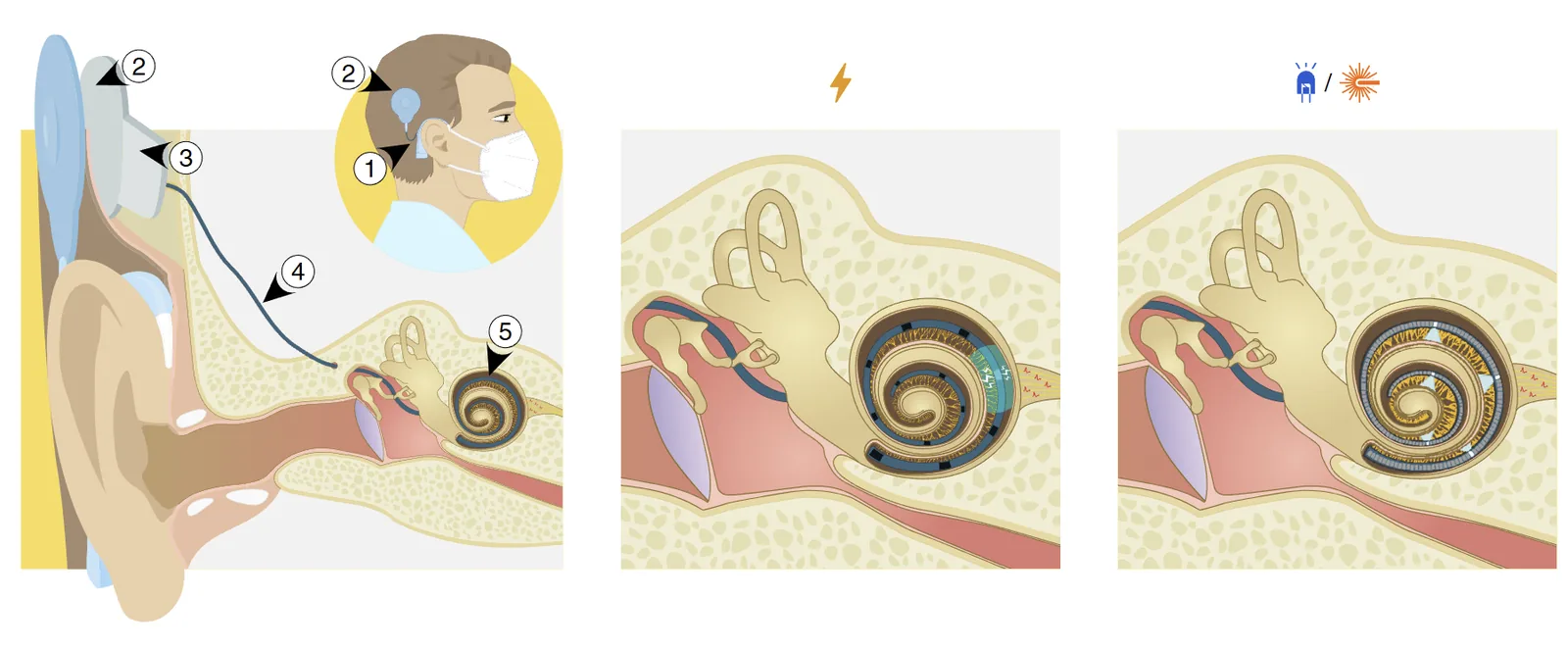
Optical cochlear implants are currently at the preclinical stage and are showing successful results in animal models. In the future, they are expected to overcome the limitations of current electrical implants and provide better sound perception.
Optical cochlear implants are opening the door to a new era in hearing technology. Although more research is needed for them to reach their full potential, the current findings appear promising.
 İşitmeAtölyesi