Your partner is kept awake all night while you insist you don't snore. Both of you are being honest. The sleeping brain does not switch sound off; it filters it.
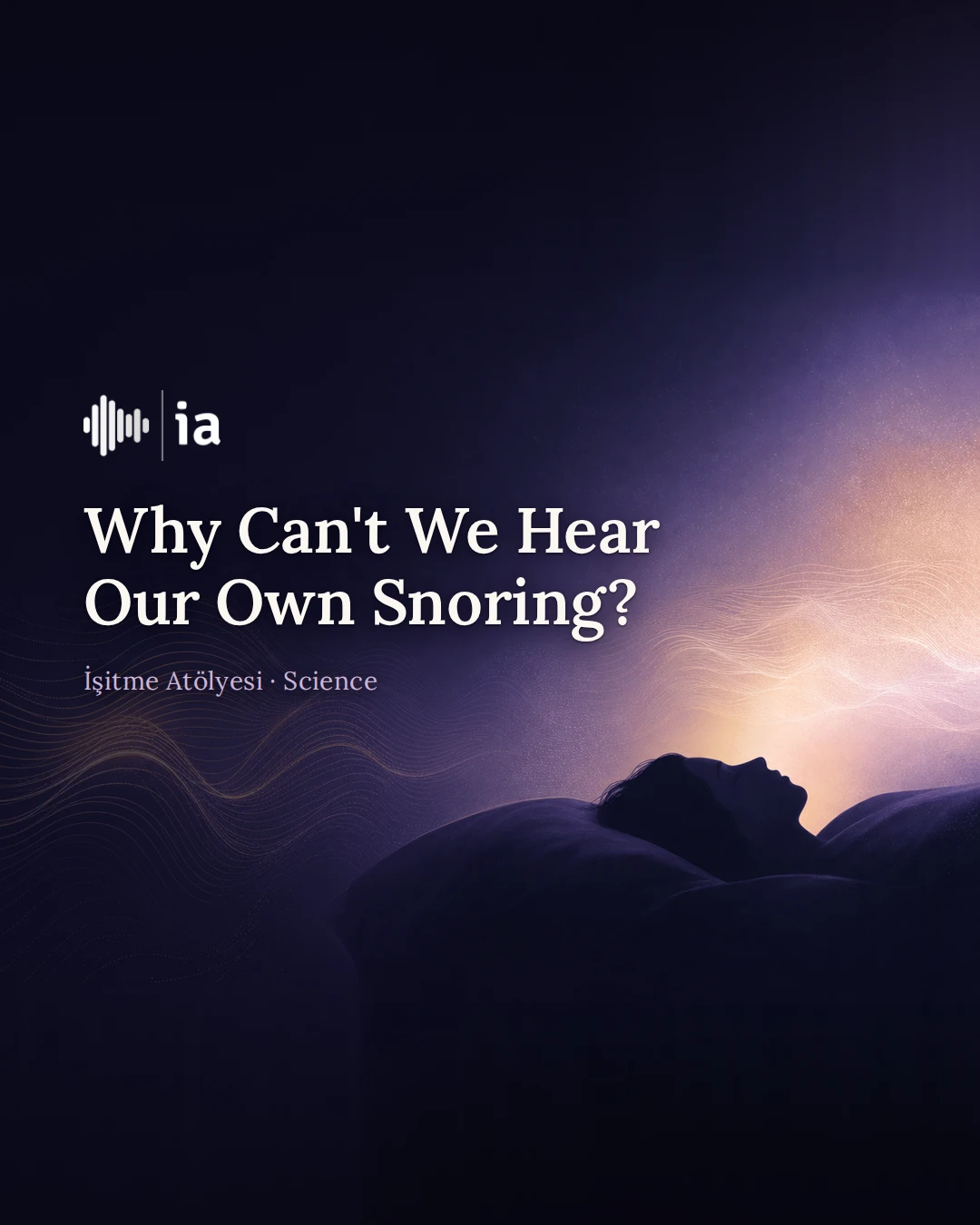
It is the oldest argument in the bedroom. One side says they could not sleep all night; the other says "but I don't snore." Neither is lying. The answer lies in how the sleeping brain handles sound.
Hearing has no eyelid. Vision is cut off mechanically during sleep; hearing has no such hardware. From the outer ear to the cochlea, the system keeps working and keeps encoding sound all night. Not hearing something in your sleep is therefore not a peripheral shutdown but a central decision.
Where that decision is made was long debated. The classic model held that sensory transmission is blocked at the thalamus during sleep spindles. Jourde and Coffey tested this directly in 2024: cortical auditory responses measured with MEG and EEG (the frequency-following response and the P100–P200 components) were not meaningfully reduced during spindles or in the refractory period right after them. Sound continues to reach auditory cortex even in the middle of a spindle.
And what reaches cortex is more than raw sound. In work by Kouider and colleagues, participants classified spoken words as “animal” or “object” while awake. After they fell asleep the test continued with new words, and the brain went on preparing a response with the hand that matched the correct category. Semantic processing continued while the person lay motionless and unaware.
So what protects sleep? A filter. Mohamed Ameen and colleagues at the University of Salzburg played recordings of familiar and unfamiliar voices to sleeping participants. Unfamiliar voices produced markedly more K-complexes and micro-arousals; familiar voices did not. The researchers call this a “sentinel processing mode”: the brain keeps monitoring the outside world while asleep, but raises the alarm only for what it does not know.
An older finding pointed the same way: when a sleeping person hears their own name, the brain produces a different response than it does to any other name. The decision is made by meaning and familiarity, not by loudness.
How the filter is set also varies between people. Dang-Vu and colleagues followed 12 participants across three nights; those with a higher sleep spindle rate on the quiet night were markedly more resistant to waking as noise was increased. The difference between someone who sleeps through anything and someone who wakes at the slightest sound is not temperament, then, but a measurable electrophysiological difference.
The rest follows on its own. Your own snoring is the most familiar, most repetitive and most predictable sound your brain will ever meet. The same every night, the same with every breath, and it arrives together with your own body's movement. There is no better candidate for the filter to wave through as "nothing new here".
Worth noting: this is not about the sound reaching you faintly. The source is a few centimetres from your ear; it reaches your cochlea abundantly, by air as well as through tissue and bone. What keeps you asleep is not the level — it is the absence of news.
The filter does not always filter. When snoring is severe, the person wakes briefly and repeatedly through the night, and none of it is remembered in the morning. Sleep research calls this mesograde amnesia: during very brief awakenings, information is not committed to lasting memory. The person really is awake at that moment, but no record survives to the next morning.
So "I never woke up" is just as weak a testimony as "I don't snore".
This has been measured directly. In a study of 1,913 patients in Israel, patients' own reports were compared with a calibrated sound meter in the sleep laboratory.
Among women who considered themselves non-snorers, 36.5% fell into the severe or very severe snoring group on measurement. The same figure was 11.7% for men. While 28% of women described themselves as non-snorers, only 6.9% of men did — yet objective measurement showed no meaningful difference in snoring intensity between the sexes.
The problem, then, is not in the ear but in awareness. And that gap is not neutral: because snoring carries a social cost, women report it even more conservatively.
Snoring is not a disease in itself, but it is the most visible sign of sleep apnoea. The practical consequence of the science is this: the information sits not with the patient but with the person sleeping beside them. When a patient says "I don't snore", that does not mean they do not snore; it means they cannot hear it.
So the question to ask may not be "do you snore?" but "has anyone sleeping near you told you that you snore, or that your breathing stops?" Where witnessed pauses in breathing or excessive daytime sleepiness accompany it, referral to the appropriate physician for a sleep assessment may be warranted.
You do not hear your own snoring because your brain works like a gatekeeper during sleep and does not let the familiar through. You wake up, but you do not remember it. And the person who can tell you most accurately how your night went is the one sleeping beside you.
Ameen, M. S., Heib, D. P. J., Blume, C., & Schabus, M. (2022). The brain selectively tunes to unfamiliar voices during sleep. Journal of Neuroscience, 42(9), 1791–1803.
Jourde, H. R., & Coffey, E. B. J. (2024). Auditory processing up to cortex is maintained during sleep spindles. PNAS Nexus, 3(11), pgae479.
Kouider, S., Andrillon, T., Barbosa, L. S., et al. (2014). Inducing task-relevant responses to speech in the sleeping brain. Current Biology, 24(18), 2208–2214.
Dang-Vu, T. T., McKinney, S. M., Buxton, O. M., et al. (2010). Spontaneous brain rhythms predict sleep stability in the face of noise. Current Biology, 20(15), R626–R627.
Perrin, F., García-Larrea, L., Mauguière, F., & Bastuji, H. (1999). A differential brain response to the subject's own name persists during sleep. Clinical Neurophysiology, 110(12), 2153–2164.
Westreich, R., Gozlan-Talmor, A., Geva-Robinson, S., et al. (2019). The presence of snoring as well as its intensity is underreported by women. Journal of Clinical Sleep Medicine, 15(3), 471–476.
Perlis, M. L., Smith, M. T., Orff, H. J., Andrews, P. J., & Giles, D. E. (2001). The mesograde amnesia of sleep may be attenuated in subjects with primary insomnia. Physiology & Behavior, 74, 71–76.
 İşitmeAtölyesi