A Cochlear Implant With No External Parts Announced: TICI UNICO Receives CE Mark
MED-EL has announced TICI UNICO, a cochlear implant whose microphone, audio processor and battery all sit under the skin. The feasibility study behind it is promising, but it included only six people.
Alperen Akbulut
29 Sep 2026
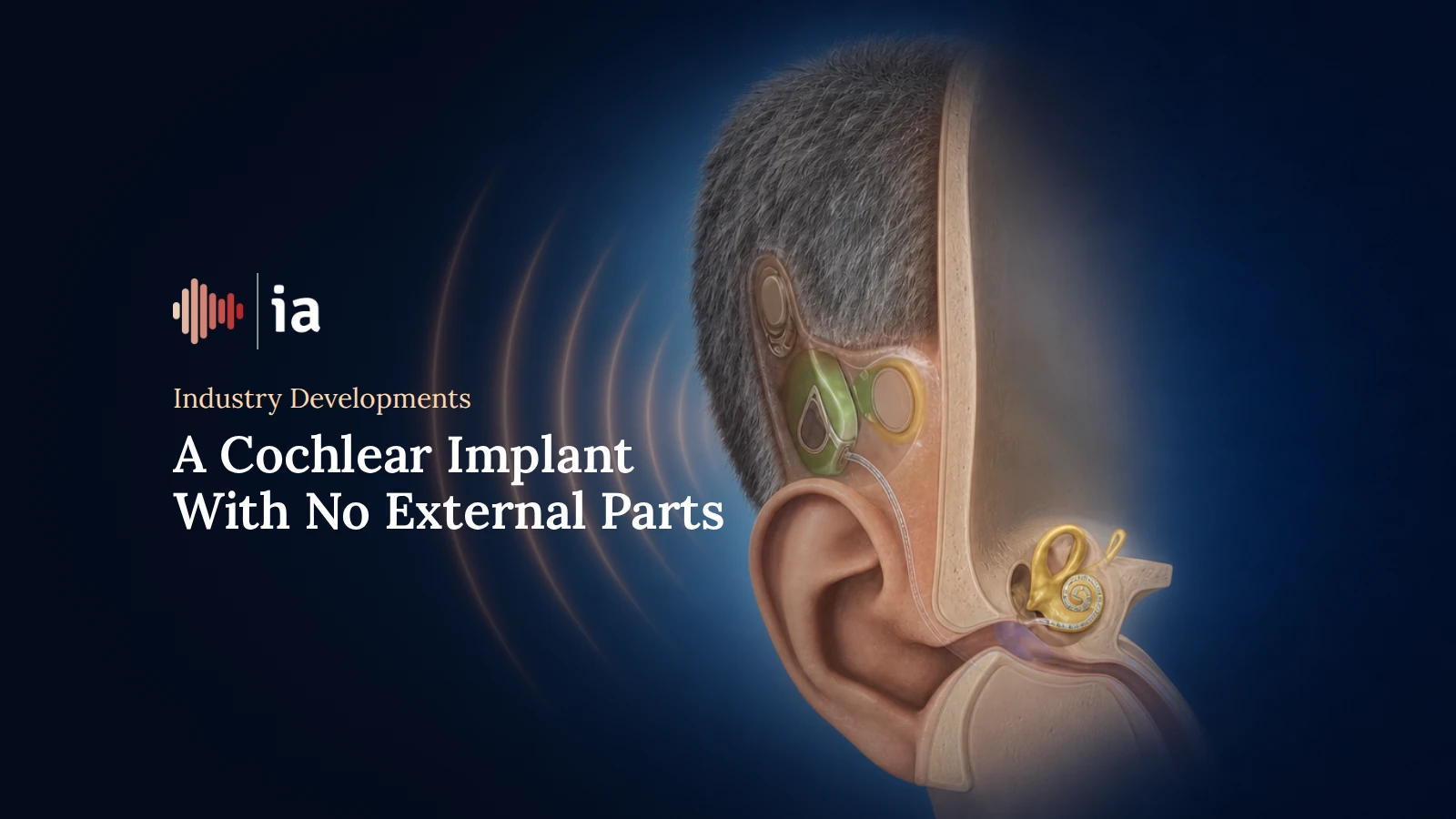
The cover image is a representative AI-generated illustration. It was made to show, based on published descriptions, how a cochlear implant sits under the skin and how the electrode array reaches the cochlea; it is not an exact image of TICI UNICO.
◈ Key points
TICI UNICO has no audio processor worn behind the ear or on the head; the microphone, processor and rechargeable battery are under the skin.
MED-EL announced the device on 29 September 2026. According to the company, it has received the CE mark and will be introduced in European markets.
In a feasibility study published in 2025, speech perception in six adults was comparable with the subcutaneous microphone and with a standard external audio processor.
The small sample, the lack of a control group and the absence of published long-term battery data mean the results should be interpreted with caution.
What was announced?
On 29 September 2026 in Innsbruck, the Austrian cochlear implant manufacturer MED-EL announced TICI UNICO, a totally implantable cochlear implant system. According to the company, the device has received the CE mark and will be introduced in European markets. MED-EL describes TICI UNICO as “the world’s first commercially available totally invisible cochlear implant”. It is intended for people with severe-to-profound sensorineural hearing loss who may benefit from a cochlear implant.
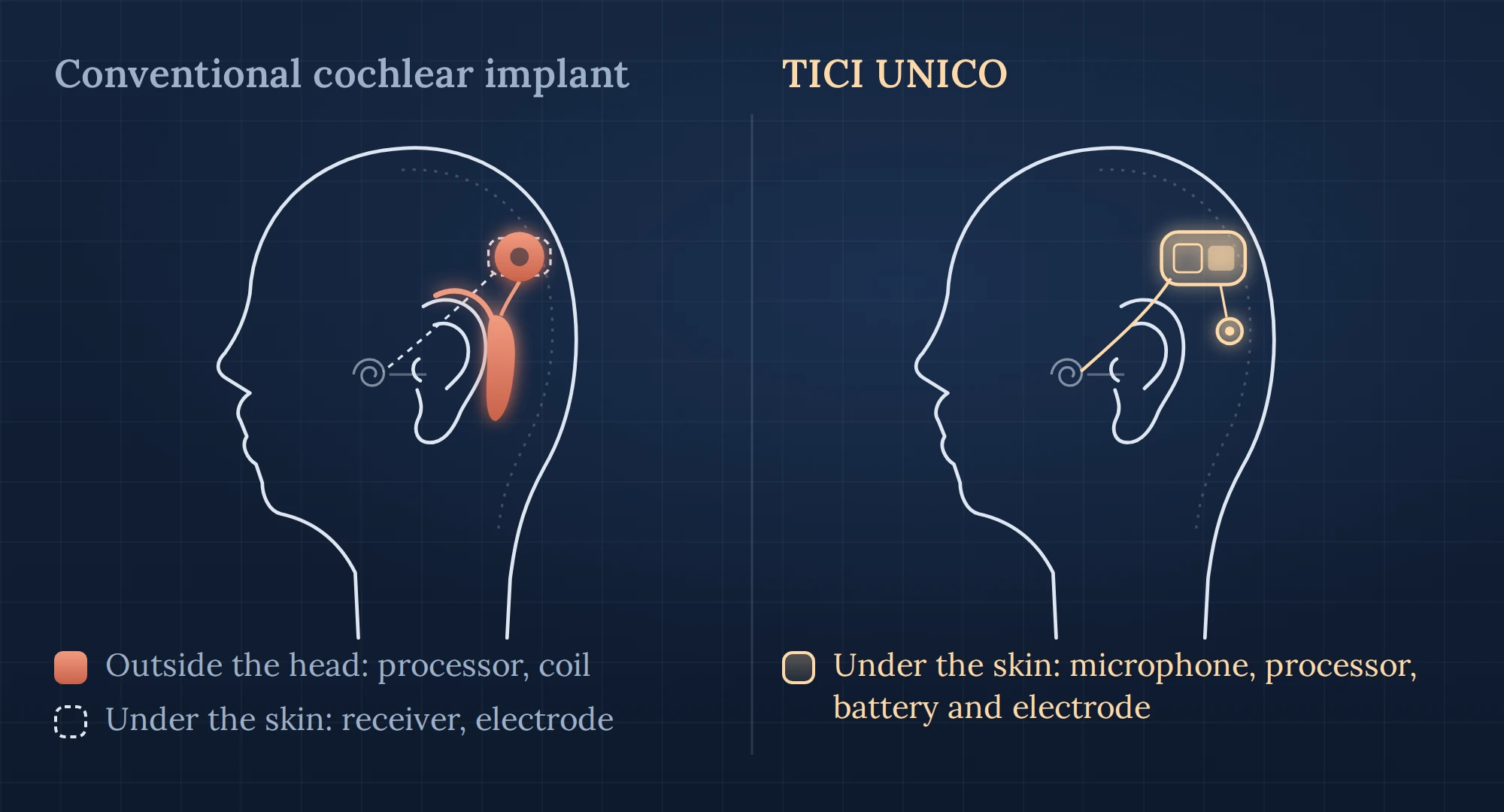
In today’s cochlear implants, the microphone that picks up sound and the processor that converts it sit in an external unit worn behind the ear or on the head. When this unit is removed, the user cannot hear. In TICI UNICO, the microphone, processor and rechargeable battery are all inside the implant. According to the company, the device works during sleep, in the shower, while swimming and while charging. The company also notes that the product and its indications are not approved in every country.
Figure 1. In a conventional cochlear implant the audio processor and coil are worn outside the head; in TICI UNICO the microphone, processor, battery and electrode are under the skin. Schematic drawing.
“TICI UNICO is a new chapter in the history of hearing. For the first time, invisible hearing with a cochlear implant is possible.”Ingeborg Hochmair, MED-EL co-founder and CEO (from the company’s press release)
The scientific basis: a feasibility study
A preliminary version of the device was tested in a feasibility study led by Prof. Philippe Lefèbvre of the University Hospital of Liège (Belgium) and Prof. Joachim Müller of LMU Munich (Germany). The results were published in Communications Medicine in 2025 (NCT04571333).
More than a decadeThe device was developed together with universities and cochlear implant centres.
September–November 2020The first surgeries took place in Liège and Munich.
2025The feasibility study results were published in Communications Medicine.
September 2026MED-EL announced the CE mark and the European introduction of the device.
6adult participants
52weeks of follow-up
4weeks to activation
18.5hours a day of use without an external processor, at most
Participants: Six adults with bilateral severe-to-profound sensorineural hearing loss took part. Their hearing loss had begun after language development (postlingual). Four were women; they were aged 20 to 80, with a mean age of 44.5 (pure-tone average 79–107 dB HL).
Comparison: Participants were also given a standard external audio processor (MED-EL SONNET). Because the same implant could run on its own subcutaneous microphone or as a conventional cochlear implant with the external processor, the two could be compared in the same ear.
Surgery: The operation used a slightly modified version of standard cochlear implant surgery, and recovery was uneventful in all participants. The device was activated four weeks after surgery.
Speech perception: Monosyllabic word tests (Freiburg and Fournier) were used in quiet and sentence tests (the Oldenburg sentence test and the French Matrix test) in noise. Results with the subcutaneous microphone were comparable to those with the external processor.
Use: Five of the six participants mostly used the implant on its own in daily life, without the external processor, for between 4.2 and 18.5 hours a day.
Safety: A total of 15 adverse events were recorded during the study. One was an anticipated serious adverse device effect (swelling and infection at the implant site), which resolved with treatment without lasting problems. No unanticipated serious adverse device effects occurred.
All of the quality-of-life questionnaires showed improvement:
Questionnaire
Before
Week 52
HUI3Health-related quality of life
0.45
0.85
SSQ-12Speech, spatial hearing and sound qualities
4.44
5.95
HISQUI19Hearing-specific quality of life
64
89
Median values; n = 6. Lefebvre et al., Communications Medicine, 2025.
The researchers point out that an earlier experimental totally implantable device performed considerably worse when used with its internal microphone alone, whereas TICI gave results comparable to the external processor. The authors also note that the small sample did not allow robust inferential statistics.
In their commentary in ENT & Audiology News, Lefèbvre and Müller report that the results have remained stable over more than four years of follow-up, with a slight tendency to improve. They add that they are awaiting larger multicentre trials to confirm the long-term outcomes.
Why does it matter?
The idea of a totally implantable cochlear implant has been pursued for a long time. An external audio processor has to be removed for showering, swimming and sleep; it can be lost or broken, leaving the user without hearing until it is repaired. The visibility of the processor has also been cited as one reason for low cochlear implant uptake.
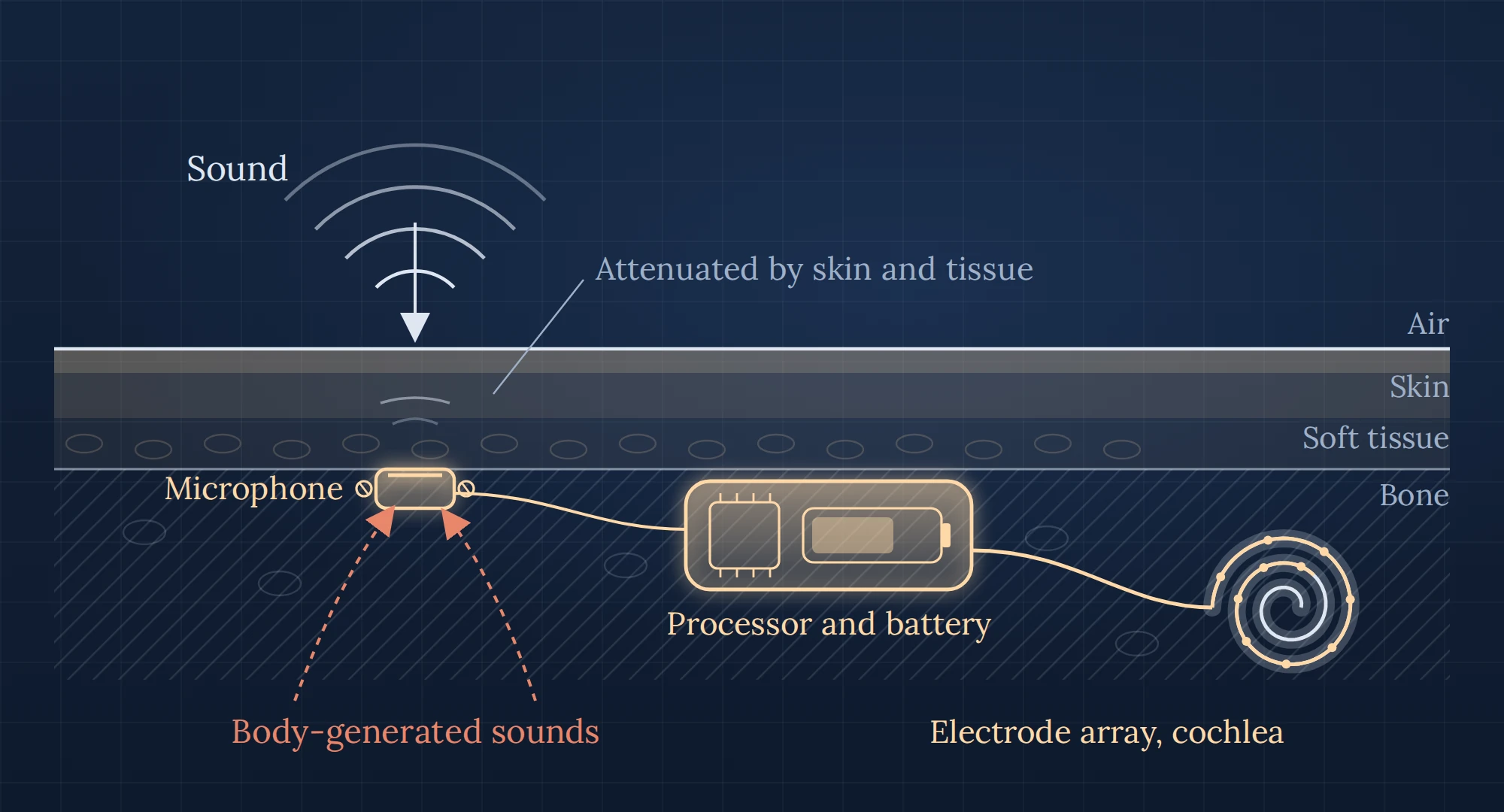
Developing a microphone that can pick up sound through skin and tissue with sufficient quality, limiting how much it picks up the body’s own sounds, and running an implanted battery safely are the main engineering problems in this field. According to the researchers, such a device must run safely for more than 24 hours without recharging, and solving these problems took more than a decade of development.
Figure 2. Sound is attenuated as it passes through skin and tissue; a subcutaneous microphone can also pick up body-generated sounds. Sound captured by the microphone goes to the processor and battery housing, and from there through the electrode array to the cochlea. Schematic drawing, not to scale.
Others are pursuing the same goal by a different route: Envoy Medical’s Acclaim device, currently in clinical trials, uses the ear’s own anatomy instead of a microphone to pick up sound.
Editor's note: This is an independent news/information article; it is not advertising or sponsored content. İşitmeAtölyesi has no commercial relationship with MED-EL. The article is not a product recommendation or medical advice.


 İşitmeAtölyesi