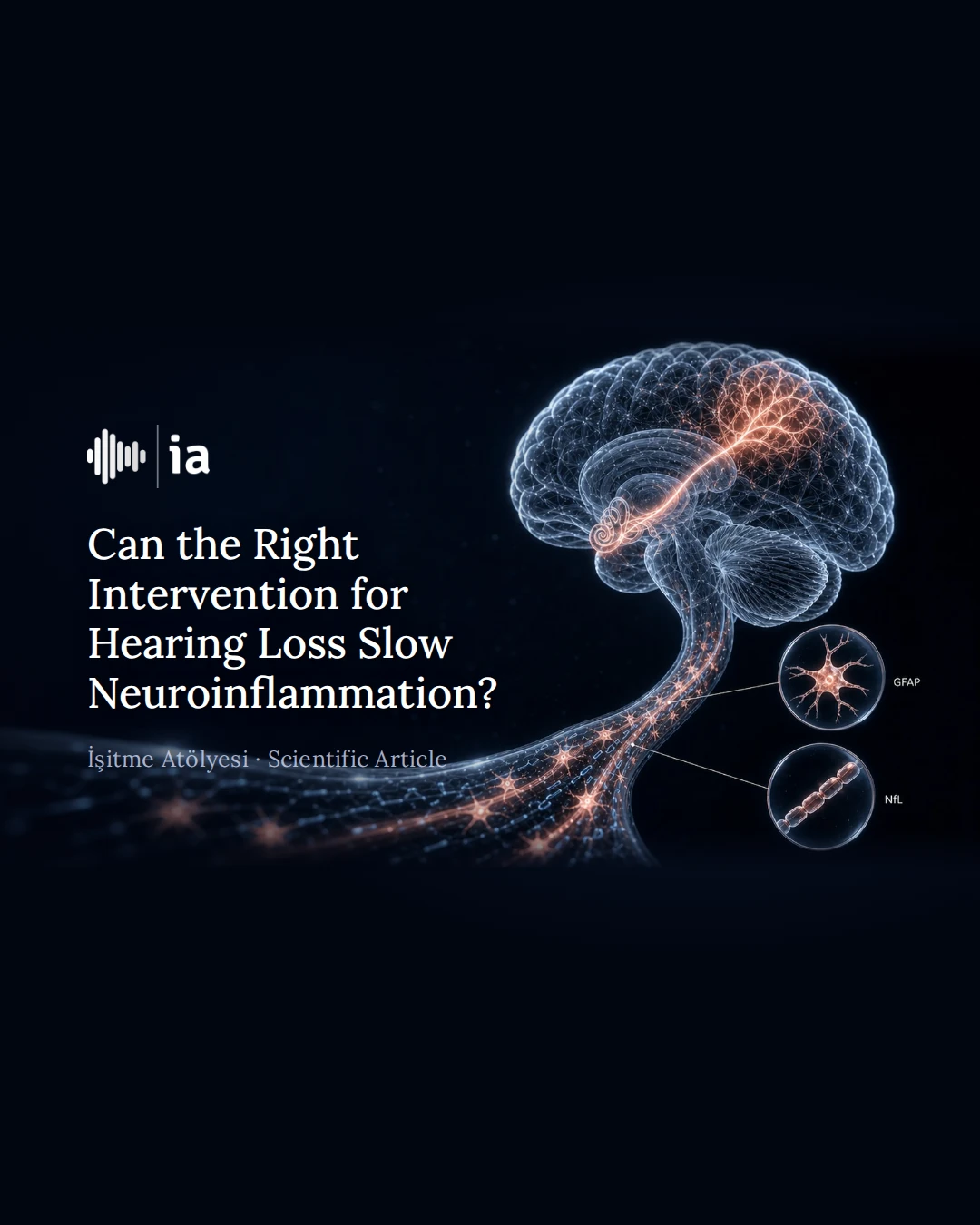
In the three-year ACHIEVE trial, GFAP, a neuroinflammation-related biomarker, rose more slowly in older adults who received a comprehensive hearing intervention than in the control group.
For many years, hearing loss was seen mainly as a communication problem. Recent research, however, shows that hearing loss, particularly when it appears later in life, is associated with cognitive decline and dementia. For this reason it is regarded as one of the important potentially modifiable risk factors for dementia. So is it possible to assess the possible effects of hearing loss and hearing intervention on brain health at a biological level?
A new randomised controlled trial asked whether a hearing intervention slows the change in blood biomarkers linked to neuroinflammation and neurodegeneration. In this article we look at the study "Effects of hearing intervention on blood-based biomarkers of neuroinflammation and neurodegeneration: a secondary analysis of the ACHIEVE randomised controlled trial", published in eClinicalMedicine in September 2026 by James Russell Pike and colleagues.
ACHIEVE (Aging and Cognitive Health Evaluation in Elders) is a multicentre randomised controlled trial conducted in the United States to examine the effect of hearing intervention on cognitive decline in older adults. Participants were aged 70 to 84, lived independently and had untreated bilateral hearing loss. Inclusion criteria included a better-ear pure-tone average at 0.5, 1, 2 and 4 kHz of 30 to 70 dB HL.
Participants were divided into two groups. The hearing intervention group received more than a hearing aid. Participants had four separate sessions with audiologists; hearing aids were fitted and verified with real-ear measurements, assistive listening technology was provided when needed, and education and counselling on communication strategies were given. Follow-up support sessions took place every six months. The control group received education on preventing chronic disease and on healthy ageing.
The researchers focused on 164 participants who had blood samples at both baseline and follow-up. Their mean age was 78.1 and their better-ear pure-tone average was about 39 dB HL.
The most notable result was for GFAP: over the three years, the change in levels was slower in the hearing intervention group than in the control group, and the difference between the groups was statistically significant, including in the adjusted analysis. NfL showed a similar difference in favour of the hearing intervention, but this result did not reach statistical significance. Although cognitive decline was seen in both groups after three years, it was slower in the hearing intervention group.
To assess the possible effects of hearing intervention on the biological processes linked to brain health, the researchers focused on two biomarkers that can be measured in blood: GFAP and NfL.
GFAP (Glial Fibrillary Acidic Protein) is a structural protein found mainly in astrocytes. Because blood GFAP levels can change with astrocyte activation or damage, GFAP is used as a biomarker linked to astrogliosis and neuroinflammatory processes. However, a rise in GFAP alone is not a direct or specific indicator of neuroinflammation.
NfL (Neurofilament Light Chain) is one of the neurofilament proteins involved in the structural integrity of neurons. Because NfL levels in cerebrospinal fluid and blood are linked to neuronal damage and neurodegenerative processes, NfL is used as a non-disease-specific biomarker of neurodegeneration.
Rises in blood GFAP and NfL can be seen in the preclinical stages of various neurodegenerative diseases, including Alzheimer's disease, but these changes are not specific to any one disease. These biomarkers therefore do not, on their own, indicate the presence of Alzheimer's disease or establish a diagnosis. In this study, too, GFAP and NfL were treated not as indicators of Alzheimer-specific pathology but as non-specific biomarkers of neuroinflammation/astroglial response and neurodegeneration.
The researchers examined pTau181, pTau217 and pTau231, which are more directly linked to Alzheimer's disease pathology, in their earlier work (Deal et al., 2025). This study therefore does not directly answer the question "Does using a hearing aid prevent Alzheimer's disease?" The central question was whether a comprehensive hearing intervention changes the rate at which these brain-health-related blood biomarkers change over time.
This study points to something important about how we think of hearing loss. The aim of hearing rehabilitation may not be only to make sounds louder or speech clearer. The findings suggest that hearing loss may be linked to biological processes related to brain health.
According to the study, appropriate and comprehensive intervention for hearing loss may slow the progression of neuroinflammation-related biomarkers in some older adults, and these changes may be seen together with a slower course of cognitive decline.
Pike, J. R., Huang, A. R., Reed, N. S., Arnold, M. L., Chisolm, T. H., Couper, D., Deal, J. A., et al. (2026). Effects of hearing intervention on blood-based biomarkers of neuroinflammation and neurodegeneration: a secondary analysis of the ACHIEVE randomised controlled trial. eClinicalMedicine, 99.
Deal, J. A., Pike, J. R., Kamath, V., Palta, P., Thyagarajan, B., Lin, F. R., et al. (2025). Audiometric hearing and plasma biomarkers of Alzheimer's disease pathology and neurodegeneration in the Atherosclerosis Risk in Communities Neurocognitive Study. Alzheimer's & Dementia, 21, e106812.
 İşitmeAtölyesi